OpenLint: a community fork of Spectral, with a spec for its rulesets
Core concept
Spectral is the linter most OpenAPI tooling reaches for, and its ruleset format is how a lot of teams write down their API style guide. The catch is that the format was never specified. It exists as configuration for one CLI, described by internal meta-schemas and versioned with the tool. If the linter stops moving, the rules you wrote in its format stop moving with it.
OpenLint is a community fork of Spectral, run in the open as an API Commons effort, that goes after exactly that. It splits the work into three pieces that don’t belong to any one tool or vendor:
- A specification for rulesets, that a linter can claim conformance with.
- A toolbox: the linter as a library, a CLI, a CI gate, an IDE integration.
- A community with open governance and an Open Collective to fund it.
Where it stands (September 2026)
It’s brand new. The GitHub org was created on 17 September 2026, the name came out of a community vote the same month, and the first roadmap draft is due at the end of September. Nothing is released yet.
The concrete work so far is in two API Commons repos under the earlier name Spotlight, and the spec is moving to the OpenLint org:
| Repo | What it is |
|---|---|
api-commons/spotlight-spec | Spectral’s ruleset format as it’s implemented today, written down without extensions, with a JSON Schema at schema/v1/spectral-ruleset.schema.json |
api-commons/spotlight-tools | The reference implementation, an API Commons build of Spectral |
Spectral itself isn’t dead: it shipped 6.16.3 in August 2026. But before 6.16.1 in June 2026, the previous release was 6.15.0 in April 2025, fourteen months earlier. That’s a good example of why I’d rather my rules didn’t depend on one CLI’s release cadence.
Why I’m watching it
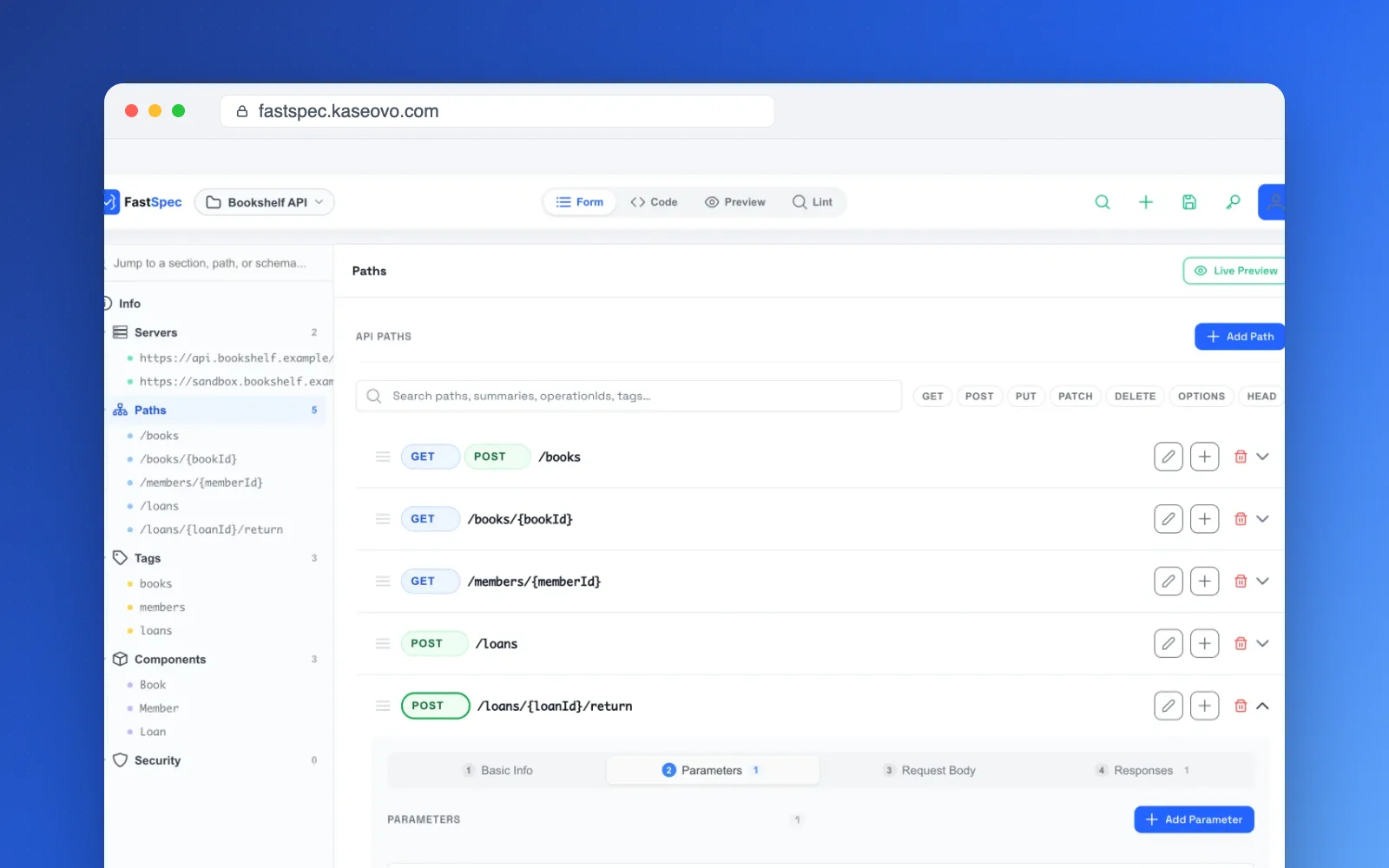
FastSpec lints specs with Spectral, and the rulesets its
users write are stored in Spectral’s format: rules built in the form become
generated YAML, and there’s a raw YAML override. The rules are the durable
part; the engine is replaceable. The backend already treats it that way.
Everything goes through a SpectralClient interface with one method,
lint(spec_json, ruleset_yaml) -> dict, and the default implementation just
shells out:
spectral lint spec.json --ruleset ruleset.yaml --format json --quietIf OpenLint ships a CLI that reads the same rulesets and prints the same JSON, switching is a new client class and a Dockerfile change. If the output differs, it’s a small adapter in the same place.
Two things are useful even before a release:
- The JSON Schema. FastSpec only checks that a raw YAML ruleset parses and
doesn’t use
functions,functionsDiror a non-spectral:extends. Validating it against the published schema at save time would catch a malformed rule before the lint run does. - A conformance suite, once there is one, to see whether the Spotlight build, vacuum and OpenLint really agree on the same rulesets.
What to check when it ships
- Is the CLI a drop-in for
spectral lint: same flags, same--format jsonoutput? - Do
extends: spectral:oasand the built-in function names stay the same? - How does it handle custom JavaScript functions? FastSpec refuses them anyway, so a stricter model would be welcome rather than a blocker.
Rule of thumb
Treat lint rules as an artifact of their own, not as one tool’s config. Keep them in a format more than one engine can read, call the engine through a small interface, and pin its version. Then a fork like OpenLint is an option to evaluate, not a migration you’re forced into.
Related
FastAPI & OpenAPI tooling
Open-source app for writing, versioning and linting OpenAPI specs
- Open source under AGPL-3.0
- $17 to $0.03 a month idle